


Key takeaways
- SBA 7(a) loans offer rates from 11.5% to 15% APR with terms up to 25 years - ideal for restaurant expansions or acquisitions
- Equipment financing covers up to 100% of kitchen equipment costs with the equipment itself serving as collateral
- Business lines of credit provide flexible access to $10,000-$500,000 for managing seasonal revenue swings
- Restaurant failure rates remain high at approximately 60% within five years, making lender requirements stricter than other industries
- Alternative lenders approve restaurant loans faster but charge 20-50% higher rates than traditional bank financing
Restaurant owners face unique financing challenges due to tight margins, seasonal fluctuations, and the industry's historically high failure rate. The optimal loan choice depends on whether you need funds for equipment, working capital, expansion, or purchasing an existing establishment. Understanding each option's requirements and costs helps you secure funding that supports rather than strains your operation.
How SmarterLends Helps With This
SmarterLends simplifies restaurant financing by matching you with lenders who specialize in food service businesses. Our platform analyzes your revenue patterns, time in business, and funding needs to present pre-qualified options from our network of over 75 lending partners. Rather than submitting multiple applications and potentially damaging your credit score, you complete one application and receive tailored offers within 24 to 48 hours. We understand restaurant-specific metrics like covers per day, food cost percentages, and seasonal revenue variations that traditional lenders often misinterpret.
SBA Loans for Restaurant Financing
SBA 7(a) Loans
The SBA 7(a) program remains the gold standard for restaurant financing, offering the lowest rates and longest terms available. In fiscal year 2025, the SBA approved over $31 billion in 7(a) loans across all industries, with accommodation and food services representing a significant portion of approvals.
These loans work best for established restaurants seeking $50,000 to $5 million for expansion, renovation, or acquiring another location. Current rates range from Prime plus 2.25% to Prime plus 2.75%, translating to approximately 11.5% to 15% APR in 2026. The primary drawback is processing time - expect 60 to 90 days from application to funding.
SBA 504 Loans
For restaurants purchasing real estate or making major fixed asset improvements, SBA 504 loans offer even lower rates. These loans require a 10% down payment from the borrower, with a Certified Development Company providing 40% and a bank covering the remaining 50%. Maximum loan amounts reach $5.5 million for standard projects.

Compare APR, term, total cost, and time to funding before deciding.
Equipment Financing for Restaurant Kitchens
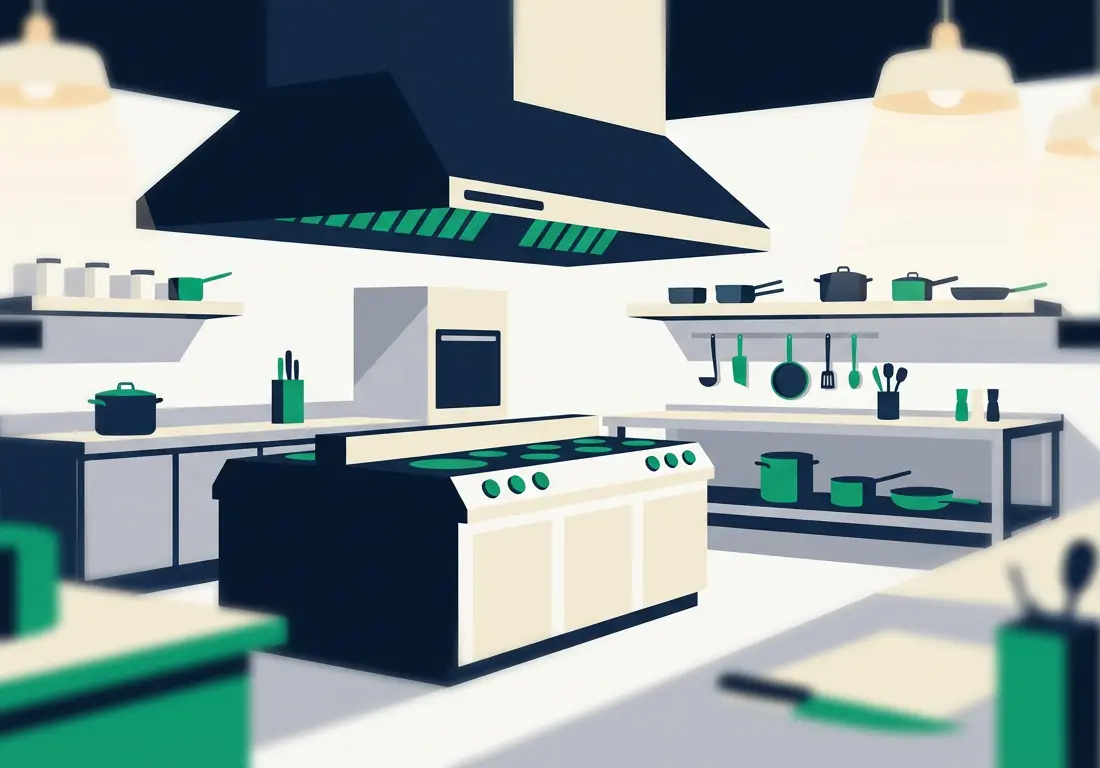 Modern commercial kitchen equipment represents a major capital investment for restaurant owners.
Commercial kitchen equipment represents one of the largest capital expenditures for restaurants. Equipment financing allows you to spread these costs over three to seven years while preserving working capital for operations.
Lenders typically finance 80% to 100% of equipment value, using the equipment itself as collateral. This self-collateralizing structure means approval depends more on equipment value and your ability to repay than on personal assets. Interest rates range from 8% to 25% depending on creditworthiness and time in business.
Eligible equipment includes:
- Commercial ovens and ranges
- Walk-in refrigerators and freezers
- Dishwashing systems
- Point-of-sale systems
- Food preparation equipment
- Ventilation and hood systems
Business Lines of Credit
Restaurants experience significant cash flow variations between busy and slow seasons. A business line of credit provides flexible access to funds when needed, with interest charged only on amounts drawn. Credit limits typically range from $10,000 to $500,000 based on annual revenue and creditworthiness.
This revolving structure works particularly well for managing inventory purchases before high-volume periods, covering payroll during slow months, and handling unexpected equipment repairs. According to the Federal Reserve's 2025 Small Business Credit Survey, approximately 43% of small businesses applied for lines of credit or business credit cards, making them the most commonly sought financing type.
Comparing Restaurant Loan Options
| Loan Type | Typical Amount | APR Range | Term Length | Time to Fund | Best For |
|---|---|---|---|---|---|
| SBA 7(a) | $50K - $5M | 11.5% - 15% | 10 - 25 years | 60 - 90 days | Expansion, acquisition |
| SBA 504 | $125K - $5.5M | 6% - 8% | 10 - 25 years | 90+ days | Real estate purchase |
| Equipment Financing | $10K - $500K | 8% - 25% | 3 - 7 years | 7 - 14 days | Kitchen equipment |
| Business Line of Credit | $10K - $500K | 10% - 35% | Revolving | 3 - 14 days | Working capital |
| Term Loan (Bank) | $25K - $1M | 9% - 18% | 1 - 5 years | 30 - 60 days | General purposes |
| Alternative Lender | $5K - $500K | 15% - 45% | 3 - 36 months | 1 - 3 days | Fast funding needs |
- APR Low
- APR High
Key Qualification Requirements
 Understanding qualification requirements helps restaurant owners prepare stronger loan applications.
Credit Score Thresholds
SBA loans typically require personal credit scores of 680 or higher, though some lenders accept 650 with strong compensating factors. Bank term loans generally require 650 to 700, while alternative lenders may approve scores as low as 550 with higher rates. Equipment financing falls in the middle, with most lenders requiring 600 or above.
Time in Business
Most traditional lenders require restaurants to operate for at least two years before qualifying for standard business loans. The Federal Reserve's 2025 Small Business Credit Survey found that firms with less than five years of operational history faced approval rates roughly 20 percentage points lower than established businesses. New restaurants may need to explore SBA microloans, equipment financing with strong personal credit, or alternative lenders willing to accept higher risk.
Revenue Documentation
Expect to provide 12 to 24 months of bank statements, tax returns, and profit and loss statements. Lenders want to see consistent revenue and positive cash flow after accounting for debt service. A debt service coverage ratio of 1.25 or higher - meaning your operating income exceeds loan payments by 25% - strengthens your application significantly.
Industry-Specific Considerations
Restaurant lending carries inherent risks that affect approval rates and terms. Bureau of Labor Statistics data from the Quarterly Census of Employment and Wages shows the accommodation and food services sector experiences higher business turnover than most industries. Lenders compensate for this risk through stricter requirements or higher rates.
Factors That Improve Approval Odds
- Strong personal credit - Demonstrates financial responsibility
- Restaurant industry experience - Reduces perceived operational risk
- Detailed business plan - Shows understanding of market and competition
- Collateral availability - Provides lender security beyond business assets
- Consistent revenue history - Proves ability to generate cash flow
- Reasonable loan amount - Requests aligned with revenue indicate realistic expectations
Red Flags Lenders Watch For
Lenders scrutinize restaurant applications for declining sales trends, excessive existing debt, limited owner equity investment, and locations in oversaturated markets. Multiple recent credit inquiries or tax liens create additional obstacles. Addressing these issues before applying improves your chances of approval at favorable terms.
Alternative Financing Options
When traditional loans prove inaccessible, several alternative options exist. Merchant cash advances provide quick funding based on credit card sales volume but carry effective APRs often exceeding 50%. Revenue-based financing offers similar speed with somewhat better terms, taking a fixed percentage of daily sales until repaid.
Investor financing represents another path - the National Restaurant Association reports many successful restaurant expansions involve silent partners or investor groups providing capital in exchange for equity stakes. This approach preserves cash flow but dilutes ownership.
Making Your Decision
The best restaurant loan balances affordability with practicality. Calculate total cost of capital including all fees and interest over the loan term. A lower-rate SBA loan costing $15,000 in total interest beats an alternative loan charging $25,000 even if the alternative funds faster.
However, opportunity costs matter too. If a prime location becomes available and requires fast closing, paying more for quick funding may generate returns exceeding the additional interest expense. Evaluate each situation based on your specific circumstances and growth objectives.
Ready to find the right financing for your restaurant? SmarterLends connects you with lenders experienced in food service businesses. Complete our streamlined application to receive personalized loan offers matched to your revenue patterns, time in business, and funding goals - typically within 48 hours.
Frequently asked questions
Sources(4)
- 1.7(a) Loan Program Overview - FY2025 DataU.S. Small Business Administration · Accessed 2026-04-21
- 2.2025 Report on Employer Firms: Small Business Credit SurveyFederal Reserve Banks · Accessed 2026-04-21
- 3.Quarterly Census of Employment and Wages - Accommodation and Food ServicesU.S. Bureau of Labor Statistics · Accessed 2026-04-21
- 4.Annual Business Survey - Business CharacteristicsU.S. Census Bureau · Accessed 2026-04-21
Continue exploring
Funding products
Related questions
Tools & calculators
Ready to see what your business qualifies for?
Check eligibility in minutes. It won't impact your credit score.