


Key takeaways
- Business lines of credit offer revolving access to capital, meaning you can draw, repay, and redraw funds as needed without reapplying
- Bank LOCs typically carry APRs from 8% to 15%, while fintech and online lenders charge 15% to 30% or higher for faster approval
- California and New York require commercial financing disclosures including estimated APR, making cost comparisons easier for borrowers in those states
- Most lenders require at least 12 months in business, $100,000+ annual revenue, and personal credit scores of 600 or higher
- Unlike term loans, you only pay interest on the amount you actually use, making LOCs ideal for managing irregular cash flow
A business line of credit gives your company on-demand access to working capital without the rigidity of a term loan. Rather than receiving a lump sum, you draw funds as needed up to your credit limit, repay what you use, and the credit becomes available again. This revolving structure makes lines of credit especially valuable for managing cash flow gaps, covering unexpected expenses, or seizing time-sensitive opportunities.
How business lines of credit work
A business line of credit functions similarly to a credit card but typically offers higher limits and lower interest rates. Your lender approves a maximum credit amount based on your company's financial health, and you access funds when needed through online transfers, checks, or sometimes a linked card.
Revolving vs non-revolving structures
Most business lines of credit are revolving, meaning your available credit replenishes as you pay down the balance. If you have a $100,000 line, draw $40,000, and repay $25,000, you have $85,000 available for future draws. Non-revolving lines exist but are less common. They work more like delayed-draw term loans where once you repay funds, you cannot borrow again without reapplying.
Draw mechanics and repayment
When you need funds, you request a draw through your lender's platform. Most lenders transfer money within one to two business days, though some offer same-day access. Repayment terms vary significantly. Some lenders require monthly interest-only payments with periodic principal reductions, while others expect weekly or daily payments calculated as a percentage of revenue.
Secured vs unsecured options
Secured lines of credit require collateral such as real estate, equipment, inventory, or accounts receivable. These typically offer higher limits and lower rates. Unsecured lines require no specific collateral but often include a personal guarantee and carry higher interest rates to offset the lender's increased risk.
Typical costs and terms
Business line of credit pricing depends heavily on lender type, your creditworthiness, and whether the line is secured. The gap between bank and fintech pricing remains substantial.
| Cost Component | Traditional Banks | Online/Fintech Lenders |
|---|---|---|
| APR Range | 8% - 15% | 15% - 30%+ |
| Draw Fee | 0% - 2% per draw | 0% - 3% per draw |
| Monthly Maintenance | $0 - $25 | $0 - $50 |
| Unused Line Fee | 0.25% - 0.50% annually | Often none |
| Origination Fee | 0% - 1% | 0% - 5% |
Fee structures to watch
Draw fees charge a percentage each time you access funds. A 2% draw fee on a $50,000 withdrawal costs $1,000 upfront. Monthly maintenance fees apply regardless of whether you use the line. Unused line fees, sometimes called commitment fees, charge a small percentage on your undrawn balance. These add up if you maintain a large credit line for emergency purposes but rarely tap it.
California and New York now require lenders to provide standardized disclosures for commercial financing products. Under California's Commercial Financing Disclosure Law, lenders must show estimated APR, total repayment amount, and payment schedule before you sign. New York's disclosure requirements similarly mandate transparency on financing costs, helping borrowers make meaningful comparisons between offers.
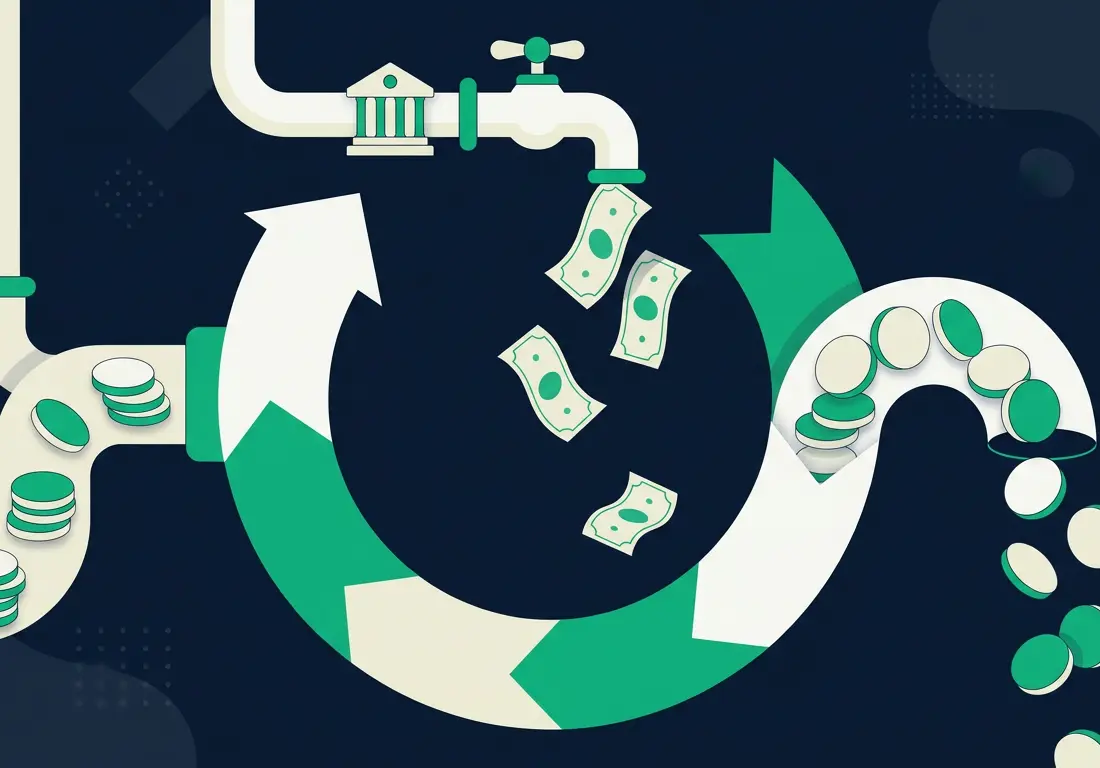
How revolving credit works — draw, repay, redraw without re-applying.
Who qualifies
Lenders evaluate business lines of credit based on time in operation, revenue consistency, personal credit, and sometimes industry type. Requirements vary substantially between banks and alternative lenders.
| Requirement | Bank LOCs | Online Lenders |
|---|---|---|
| Time in Business | 24+ months | 6-12 months |
| Annual Revenue | $250,000+ | $100,000+ |
| Personal Credit Score | 680+ | 550-600+ |
| Collateral | Often required | Usually not required |
| Documentation | Tax returns, financials | Bank statements |
Why banks set higher bars
Traditional banks offer the lowest rates but impose the strictest requirements. They want established businesses with proven cash flow and owners with strong personal credit. The underwriting process takes longer, often two to four weeks, and requires comprehensive documentation including tax returns, profit-and-loss statements, and balance sheets.
How fintech lenders differ
Online lenders accept higher-risk borrowers in exchange for higher pricing. Many approve businesses with just six months of operating history by analyzing bank statements rather than tax returns. This approach allows faster decisions, sometimes within hours, but comes with APRs that can exceed 30% for borrowers with weaker profiles.
Business lines of credit vs alternatives
Choosing the right financing depends on your specific needs, timeline, and cost tolerance. Here's how lines of credit compare to other SmarterLends product categories.
| Feature | Business Line of Credit | SBA 7(a) Loan | Merchant Cash Advance |
|---|---|---|---|
| Funding Structure | Revolving access | Lump sum | Lump sum |
| Typical APR | 8% - 30%+ | 10.5% - 15.5% | 40% - 150%+ factor rate equivalent |
| Funding Speed | 1-14 days | 30-90 days | 1-3 days |
| Repayment | Monthly or weekly | Fixed monthly | Daily percentage of sales |
| Best For | Ongoing working capital | Major expansion, equipment | Urgent cash, weak credit |
When LOCs beat term loans
Term loans work well when you know exactly how much you need and want predictable payments. Lines of credit excel when your capital needs fluctuate. If you draw $50,000 one month and only $10,000 the next, a LOC saves you from paying interest on unused funds.
When to avoid MCAs
Merchant cash advances provide fast funding but at extreme cost. The California Department of Financial Protection and Innovation requires MCA providers to disclose estimated APR, which often reveals effective rates exceeding 100%. A line of credit almost always costs less if you qualify.
Secured lines of credit usually offer higher limits and lower rates.
When business lines of credit are the right fit
Not every business needs a line of credit, but certain situations make this financing structure particularly valuable.
Managing seasonal revenue swings
A landscaping company generates 70% of annual revenue between April and October. A line of credit bridges the lean winter months, covering payroll and fixed costs until spring brings renewed cash flow. You draw during slow periods and repay when revenue picks up.
Covering cash flow gaps from slow-paying customers
When large clients pay on 60 or 90-day terms, your operating expenses don't wait. A line of credit lets you cover payroll, rent, and supplier invoices while awaiting payment. Once receivables arrive, you pay down the line.
Seizing time-sensitive opportunities
A supplier offers 15% off inventory if you pay within ten days. Your cash reserves won't stretch, but a quick draw from your credit line captures the discount. The math often works: a 2% draw fee costs far less than the 15% you save.
Building a financial safety net
Some businesses maintain a line of credit without immediate need. Having approved credit available means you're prepared for equipment breakdowns, insurance deductibles, or sudden market opportunities without scrambling to apply under pressure.
Funding recurring operational needs
Businesses with regular but variable expenses benefit from LOC flexibility. A restaurant owner might draw $20,000 for a large catering order's supplies, repay it when the client pays, then draw again next month for a different amount.
Market data
The business credit landscape continues evolving as traditional banks maintain conservative underwriting while fintech lenders expand their market share.
- APR Low
- APR High
Recent corporate credit facility activity demonstrates the scale of revolving credit in today's market. Jefferson Capital recently secured an expansion of its revolving credit facility, with the amended agreement increasing maximum future commitments to $1.425 billion. Similarly, Keysight Technologies entered a new five-year unsecured revolving credit facility totaling $750 million, replacing its prior 2021 agreement. These large-scale facilities illustrate how established companies leverage revolving credit for operational flexibility.
For small businesses, the most recent Federal Reserve Small Business Credit Survey shows that lines of credit remain among the most frequently sought financing products. Bank approval rates for small business credit tend to exceed those of online lenders, though online lenders fill gaps for businesses that don't meet bank requirements.
The Consumer Financial Protection Bureau continues refining fair lending rules, with recent regulatory adjustments affecting coverage thresholds and reporting criteria for lenders. These changes aim to improve market transparency and protect borrowers from discriminatory practices.
How to apply
Preparing thoroughly before you apply improves your chances of approval and helps you secure better terms.
Assess your credit profile. Check your personal credit score and review your business credit reports if established. Scores below 680 may limit you to online lenders with higher rates.
Gather financial documentation. Prepare at least six months of business bank statements, recent tax returns if applying to a bank, and current profit-and-loss statements.
Calculate how much credit you need. Request enough to cover realistic working capital needs without overextending. Lenders scrutinize requests that seem disconnected from your revenue.
Compare multiple offers. Apply with several lenders to compare APRs, fee structures, and terms. California and New York borrowers receive standardized disclosures that simplify comparison.
Review all terms before signing. Pay attention to draw fees, maintenance fees, unused line fees, and any prepayment penalties. Calculate the total cost based on your expected usage pattern.
Complete the application. Submit required documents, respond promptly to lender requests, and provide additional information if needed to finalize approval.
A business line of credit offers working capital flexibility that term loans simply cannot match. If your company faces variable funding needs, seasonal revenue patterns, or wants emergency capital on standby, explore your line of credit options through SmarterLends. Our platform matches your business profile with lenders offering competitive rates and terms tailored to your situation. Start your application today to see what you qualify for.
Editorial standards. SmarterLends is a referral marketing platform and earns compensation when users connect with funding partners. Our product information is editorially independent and grounded in named primary sources (regulators, federal agencies, industry trade groups). See our Disclosures for details.
Frequently asked questions
Sources(10)
- 1.Jefferson Capital Secures Credit Facility ExpansionGlobeNewswire · Accessed 2026-04-24
- 2.Keysight Technologies amends credit agreement to secure $750 million revolving facilityInvesting.com · Accessed 2026-04-24
- 3.CFPB Final Rule on Credit Unchanged From Industry-Supported ProposalPYMNTS · Accessed 2026-04-24
- 4.Merchant Cash Advance Lawsuits in California: MCA ReliefCredible Law · Accessed 2026-04-24
- 5.Is an MCA Contract Illegal in California? Merchant Cash Advance GuideCalifornia Department of Financial Protection and Innovation via Credible Law · Accessed 2026-04-24
- 6.SBA Loan Rates April 2026NerdWallet · Accessed 2026-04-24
- 7.Smart Cash Flow Solutions for Seasonal BusinessesWisconsin Scorpions · Accessed 2026-04-24
- 8.Business Banking Solutions & ServicesBluevine · Accessed 2026-04-24
- 9.Small Business Bank Accounts, Loans & Credit CardsTruist · Accessed 2026-04-24
- 10.Consumer Credit Health after the 2025 St. Louis TornadoFederal Reserve Bank of St. Louis · Accessed 2026-04-24
Funding Estimator
Compare options for your business
Day-to-day operations, payroll, inventory.
Illustrative estimate only. Actual rates, terms, and eligibility depend on your application.
Continue exploring
Related questions
Tools & calculators
Ready to see what your business qualifies for?
Check eligibility in minutes. It won't impact your credit score.