


Key takeaways
- Invoice factoring is not a loan - it is a sale of receivables that does not create debt on your balance sheet
- Advance rates typically range from 85-97% of invoice value, with same-day or next-day funding available
- Factoring fees generally run 1-5% per month, varying based on invoice volume, customer creditworthiness, and recourse terms
- Most state commercial financing disclosure laws (including California and New York) exclude true factoring from disclosure requirements since it is a receivables sale rather than financing
- Factors file UCC-1 financing statements to perfect their security interest in your accounts receivable
Invoice factoring transforms outstanding B2B invoices into working capital without creating traditional debt. Unlike loans where you borrow against receivables, factoring involves selling those invoices outright to a third-party factor who advances most of the invoice value immediately and collects payment directly from your customers.
This distinction matters for your balance sheet, your regulatory obligations, and how quickly you can access funds. Businesses with strong commercial customers but slow-paying contracts often find factoring provides the cash flow bridge they need to take on new orders, cover payroll, or manage seasonal fluctuations.
How invoice factoring works
The factoring process follows a straightforward cycle that repeats with each batch of invoices you submit.
Step 1: Submit invoices
After delivering goods or services to your B2B customers, you generate invoices as usual. Instead of waiting 30, 60, or 90 days for payment, you submit those invoices to your factoring company. Most factors accept invoices through online portals where you upload documentation including proof of delivery.
Step 2: Receive the advance
The factor verifies the invoice and your customer's creditworthiness, then advances a percentage of the invoice face value. Advance rates typically run between 90% and 97% of invoice value in the freight industry, with many factors offering same-day funding once verification completes.
Step 3: Customer pays the factor
Your customer remits payment directly to the factoring company when the invoice comes due. This is the key difference from invoice financing, where you retain collection responsibilities and simply use invoices as collateral for a loan.
Step 4: Receive the reserve minus fees
Once your customer pays, the factor releases the remaining balance (the reserve) minus their factoring fee. For example, on a $10,000 invoice with a 95% advance rate and 3% factoring fee, you would receive $9,500 upfront and $200 when your customer pays (the $500 reserve minus the $300 fee).
Notification vs non-notification factoring
Factoring arrangements come in two primary structures based on customer awareness:
Notification factoring informs your customers that their payments should go to the factor. The invoice includes new remittance instructions, and the factor handles collections directly. This transparent approach typically commands lower fees because the factor has more control over the collection process.
Non-notification factoring keeps your customers unaware of the factoring relationship. Payments still flow through accounts controlled by the factor, but customer-facing communications appear to come from your business. This confidential structure carries higher fees due to increased administrative complexity and collection risk.
UCC-1 filing requirements
Factoring companies file UCC-1 financing statements with your state's Secretary of State office to perfect their security interest in your accounts receivable. This public filing establishes the factor's priority claim on the receivables you sell to them and is standard practice across the industry. The UCC lien protects the factor's interest and signals to other potential creditors that your receivables are already encumbered.
Typical costs and terms
Factoring costs depend on several variables including your monthly volume, customer credit quality, industry, and whether you choose recourse or non-recourse terms.
| Cost Component | Typical Range | Notes |
|---|---|---|
| Advance rate | 85-97% | Higher for freight and established relationships |
| Factoring fee | 1-5% per month | Charged on invoice face value |
| Additional fee per 30 days | 0.5-1.5% | Applied if customer pays late |
| ACH/wire fee | $0-35 per transfer | Some factors include free transfers |
| Setup/origination fee | $0-500 | Often waived for larger volume commitments |
| Monthly minimum fee | $0-500 | Required if you factor below threshold volume |
Recourse vs non-recourse factoring
Recourse factoring means you remain liable if your customer fails to pay. If an invoice goes unpaid beyond a specified period (typically 60-90 days), the factor can require you to buy back the invoice or replace it with a performing account. Recourse arrangements carry lower fees because the factor bears less credit risk.
Non-recourse factoring transfers the credit risk to the factor. If your customer cannot pay due to insolvency or bankruptcy, you keep the advance without repurchase obligations. However, non-recourse terms typically exclude disputes over goods or services delivered, meaning you still bear performance risk. Non-recourse factoring commands higher fees to compensate for the additional risk the factor assumes.
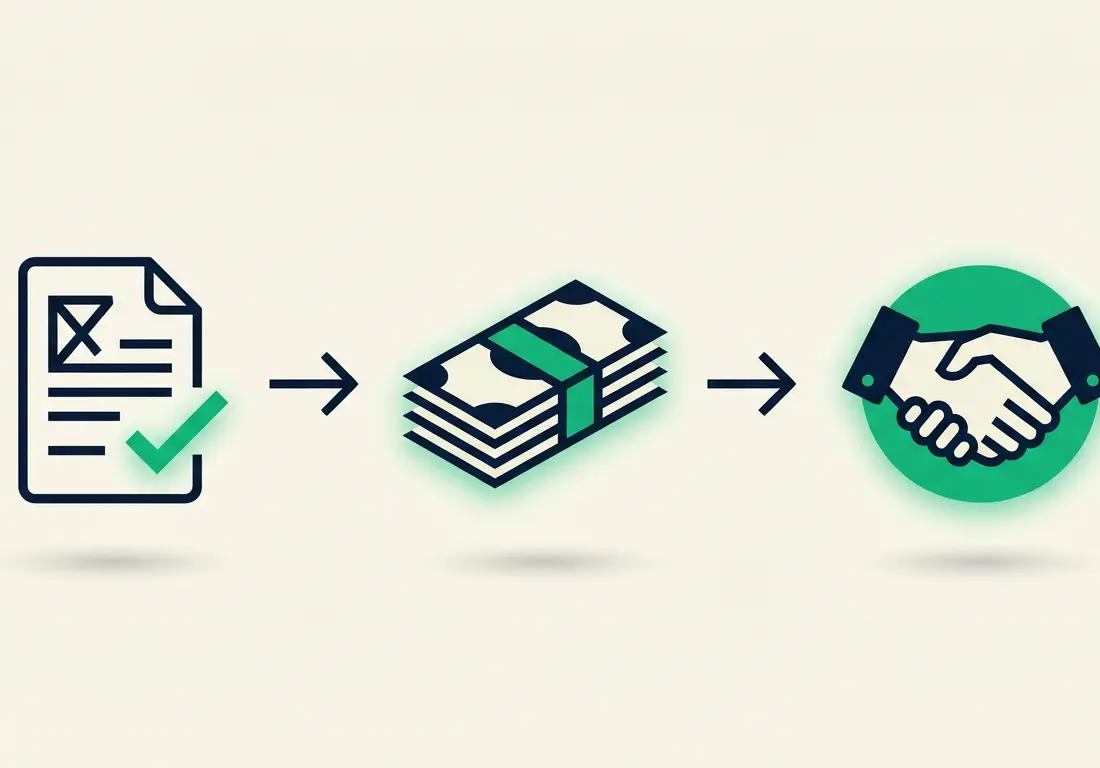
How factoring works: sell the invoice, get cash today.
Who qualifies
Factoring qualification focuses primarily on your customers' creditworthiness rather than your own business credit profile, making it accessible to newer businesses and those recovering from financial difficulties.
| Qualification Factor | Typical Requirement |
|---|---|
| Business type | B2B with commercial invoices |
| Minimum time in business | 3+ months (some factors accept startups) |
| Monthly invoice volume | $5,000-25,000 minimum |
| Customer credit quality | Creditworthy commercial customers |
| Invoice payment terms | Net 30 to Net 90 |
| Your credit score | Minimal impact (customer credit matters more) |
| Industry | Most B2B sectors; freight, manufacturing, staffing common |
Industries commonly using factoring
Factoring works particularly well for industries with extended payment cycles and creditworthy end customers:
- Freight and trucking - Carriers factor broker invoices to cover fuel, maintenance, and driver pay while awaiting payment
- Staffing agencies - Fund weekly payroll while waiting 30-60 days for client payments
- Manufacturing - Bridge the gap between materials purchases and customer remittance
- Wholesale distribution - Maintain inventory levels without straining cash reserves
- Government contractors - Access cash quickly while awaiting lengthy government payment cycles
Invoice factoring vs alternatives
Comparing factoring to other SmarterLends financing options helps clarify when each solution fits best.
| Feature | Invoice Factoring | Business Line of Credit | Revenue-Based Financing |
|---|---|---|---|
| Structure | Sale of receivables | Revolving credit facility | Fixed repayment from revenue |
| Creates debt | No | Yes | Varies by structure |
| Funding speed | 24-48 hours | 1-2 weeks initial; same-day draws | 3-7 days |
| Collateral | Invoices sold | General business assets | Future revenue |
| Customer involvement | Direct (notification) or indirect | None | None |
| Credit focus | Customer creditworthiness | Your business credit | Revenue consistency |
| Typical cost | 1-5% per month | 8-24% APR | 1.1-1.5 factor rate |
| Best for | B2B with slow-paying customers | Ongoing working capital needs | Predictable recurring revenue |
- Days

Recourse factoring is cheaper; non-recourse shifts default risk to the factor.
When invoice factoring is the right fit
Factoring solves specific cash flow challenges better than alternative financing methods. Consider factoring when these scenarios apply to your business.
Rapid growth outpacing cash flow
Winning a major contract creates a paradox: you need to fulfill orders before customers pay, but fulfillment requires cash you do not have yet. A staffing agency landing a large warehouse client needs to fund weekly payroll immediately while the client pays on net-45 terms. Factoring converts those receivables to cash the same week you bill, enabling growth without taking on debt.
Customers with strong credit but slow payment
When you sell to Fortune 500 companies, government agencies, or established enterprises, payment eventually arrives but often takes 60-90 days. Your customers' creditworthiness makes your invoices highly factorable at favorable rates. A packaging supplier selling to major retailers can factor those blue-chip receivables at lower fees than a company selling to small businesses.
Limited access to traditional financing
Businesses with short operating histories, prior credit issues, or limited collateral often struggle to qualify for bank loans. Because factoring depends on customer credit rather than your own, it provides an alternative path to working capital. A trucking company operating for eight months with one truck can factor its freight invoices even though most banks would decline a term loan application.
Seasonal demand fluctuations
Businesses with dramatic seasonal swings need cash during buildup periods before peak season revenue arrives. A landscaping supply company might factor heavily in spring to stock inventory, then use fall collections to cover winter overhead. Factoring scales with your invoice volume rather than requiring fixed monthly payments like term debt.
Avoiding additional debt
Since factoring is a sale rather than a loan, it does not appear as debt on your balance sheet. This matters for businesses maintaining specific debt-to-equity ratios for existing loan covenants or preparing for future equity investment. The transaction accelerates collection rather than adding liabilities.
Market data
The factoring industry continues expanding as businesses seek flexible working capital solutions that do not require taking on traditional debt.
- Advance Rate Low
- Advance Rate High
Factoring relationships typically involve ongoing arrangements rather than one-time transactions. Most factors prefer clients who will submit invoices regularly, creating predictable volume that justifies the customer verification and account setup process.
Regulatory treatment
Most state commercial financing disclosure laws specifically exclude true factoring from their requirements. California's Commercial Financing Disclosure Law (CFDL) and New York's Commercial Financing Disclosure Law both carve out accounts receivable purchase transactions - the legal classification for factoring - from mandatory APR and total cost disclosures required for loans and merchant cash advances.
This distinction matters because factoring involves selling an asset (your receivable) rather than borrowing money secured by that asset. The factor becomes the owner of the receivable with rights to collect directly from your customer, rather than holding it as collateral against a loan. However, if a factoring arrangement includes recourse provisions that function more like a loan guarantee, state regulators may examine whether the substance of the transaction aligns with its form.
FTC scrutiny of marketing practices
The Federal Trade Commission has increased attention on commercial financing marketing practices, particularly where the line between factoring, merchant cash advances, and loans becomes blurred. FTC enforcement actions have targeted companies making deceptive claims about their products' nature and terms, signaling that accurate product descriptions and clear fee disclosures matter regardless of regulatory carve-outs.
How to apply
SmarterLends connects businesses with factoring companies matched to their industry, volume, and customer profile. The application process moves quickly compared to traditional lending.
Complete the online application - Provide basic business information including industry, monthly invoice volume, typical customer payment terms, and a sample customer list
Submit documentation - Upload recent invoices, accounts receivable aging reports, and proof of delivery for current outstanding invoices
Customer verification - The factor reviews your major customers' credit profiles to assess risk and set advance rates
Receive your offer - Review proposed advance rates, factoring fees, and contract terms from matched factors
Complete account setup - Sign the factoring agreement, establish the payment remittance process, and receive your UCC-1 filing notification
Submit your first invoices - Upload verified invoices and receive advances within 24 hours of approval
Invoice factoring provides immediate access to capital locked in your accounts receivable without creating traditional debt. Whether you are funding rapid growth, bridging seasonal gaps, or simply accelerating cash flow from slow-paying customers, factoring offers a flexible solution scaled to your actual sales volume.
Ready to convert your invoices to working capital? Complete SmarterLends' online application to receive matched offers from factoring companies serving your industry. Most businesses receive initial funding within 48 hours of submitting their first invoices.
Editorial standards. SmarterLends is a referral marketing platform and earns compensation when users connect with funding partners. Our product information is editorially independent and grounded in named primary sources (regulators, federal agencies, industry trade groups). See our Disclosures for details.
Frequently asked questions
Sources(10)
- 1.You Delivered That Load Three Weeks Ago. Here Is Why You Still Do Not Have the MoneyFreightWaves · Accessed 2026-04-24
- 2.Understanding Invoice FactoringDiesel Jack · Accessed 2026-04-24
- 3.B2B Invoice Financing: Accelerating Cash Flow Without Increasing Long-Term DebtROK Financial · Accessed 2026-04-24
- 4.Tradewind Finance Provides USD 2.5 Million Non-Recourse Export Factoring FacilityStraits Times · Accessed 2026-04-24
- 5.How to Fight a Merchant Cash Advance Lawsuit in CaliforniaCredible Law · Accessed 2026-04-24
- 6.Business Financing Glossary: Every Term Small Business Owners Need to KnowCrestmont Capital · Accessed 2026-04-24
- 7.Southstar Capital Delivers $7.5MM A/R and Inventory FacilityABF Journal · Accessed 2026-04-24
- 8.How Much Do Freight Factoring Companies Cost?Porter Freight Funding · Accessed 2026-04-24
- 9.Tiptree Financial Core Services OverviewDefense World · Accessed 2026-04-24
- 10.FTC Order in TruHeight Case Signals Scrutiny of Marketing ClaimsNutraIngredients · Accessed 2026-04-24
Funding Estimator
Compare options for your business
Day-to-day operations, payroll, inventory.
Illustrative estimate only. Actual rates, terms, and eligibility depend on your application.
Continue exploring
Related questions
Tools & calculators
Ready to see what your business qualifies for?
Check eligibility in minutes. It won't impact your credit score.