


Key takeaways
- Factor rates of 1.1-1.5 mean repaying $1.10-$1.50 for every $1 advanced, often within 3-18 months
- Daily or weekly holdbacks of 10-20% of sales continue until the purchased amount is collected
- Five states now mandate APR-equivalent disclosures: California, New York, Virginia, Utah, and Kansas
- The January 2025 Yellowstone Capital settlement cancelled approximately $534 million in debt for over 18,000 businesses
- MCAs work best for businesses with strong daily card sales needing fast capital without fixed monthly payments
Merchant cash advances provide fast capital to businesses by purchasing a portion of future receivables at a discount. Unlike traditional loans, repayment fluctuates with your sales volume - when revenue dips, so do your payments. This flexibility comes at a cost: MCAs typically carry effective annual percentage rates far exceeding conventional financing.
Before pursuing an MCA, understanding the mechanics, true costs, and recent regulatory developments helps you make an informed decision about whether this financing structure fits your situation.
How merchant cash advance works
An MCA is not technically a loan. Instead, a funding company purchases a portion of your future sales at a discount, providing you immediate capital in exchange for the right to collect a percentage of your daily or weekly revenue until they recover the purchased amount.
The basic structure
When you receive an MCA, you agree to sell a specific dollar amount of future receivables. For example, if you receive $50,000 with a factor rate of 1.3, you owe $65,000 in total - the $50,000 advance plus $15,000 in fees. The funder collects this through automatic deductions from your business bank account or payment processor.
Factor rates explained
Unlike interest rates that accrue over time, factor rates represent a fixed multiplier applied to your advance amount. A factor rate of 1.25 means you repay $1.25 for every $1.00 received, regardless of how quickly you pay. This structure means faster repayment actually increases your effective annual cost since you pay the same fee over a shorter period.
Daily or weekly holdbacks
Most MCAs use automatic clearing house debits to collect a fixed percentage - typically 10% to 20% - of your daily credit card sales or bank deposits. Some structures use fixed daily payments instead. The holdback continues until the full purchased amount is collected, which usually takes 3 to 18 months depending on your sales volume.
Reconciliation provisions
Legitimate MCA agreements include reconciliation clauses allowing payment adjustments when your revenue drops significantly. California's Commercial Financing Disclosure Law and similar state statutes now require funders to explain these terms clearly. However, some contracts include reconciliation language that functions minimally in practice, a concern highlighted in recent enforcement actions.
Typical costs and terms
MCA costs vary substantially based on your business profile, industry risk, and the funder's underwriting standards. The table below reflects ranges commonly seen in the market:
| Cost Component | Typical Range | Notes |
|---|---|---|
| Factor rate | 1.10 - 1.50 | Multiplied by advance amount |
| Effective APR | 40% - 350%+ | Depends on repayment speed |
| Daily holdback | 10% - 20% | Percentage of daily sales |
| Repayment term | 3 - 18 months | Based on sales volume |
| Origination fees | 0% - 3% | Often built into factor rate |
| Broker fees | 5% - 10% | May be separate or embedded |
The Yellowstone Capital enforcement action revealed implied APRs reportedly reaching 820% in some cases, demonstrating how factor rates can translate to extreme effective costs when repayment occurs quickly.
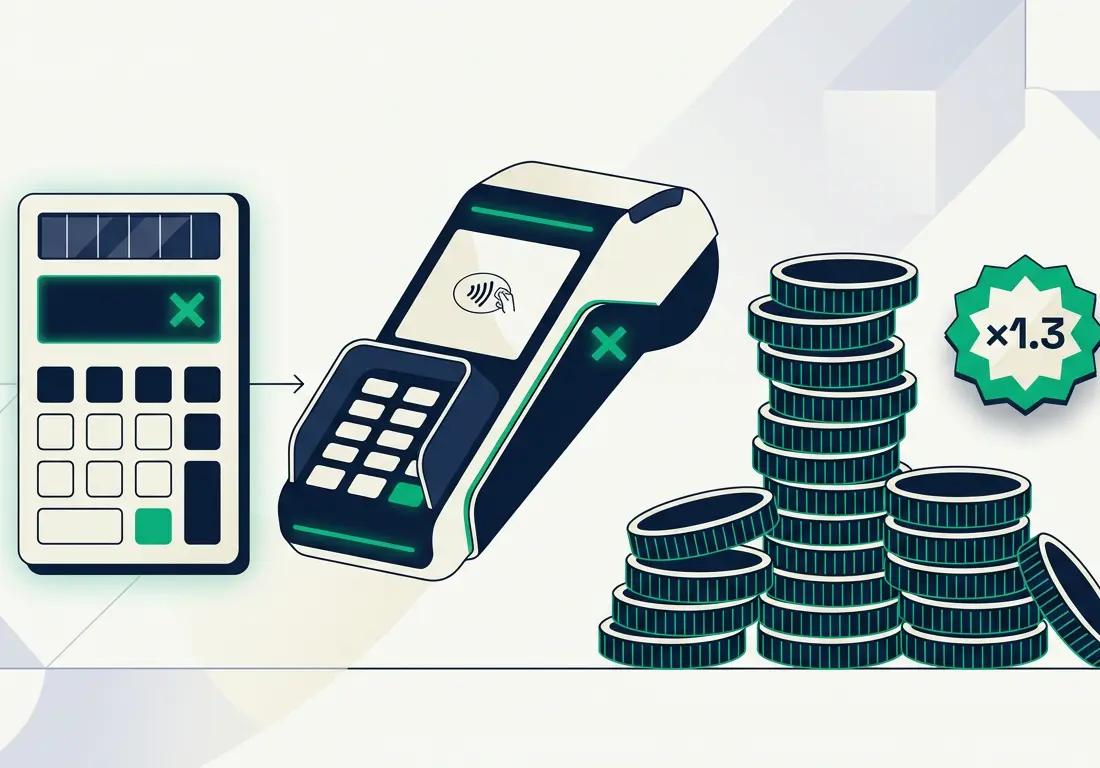
MCAs use a factor rate, not an APR — total payback is fixed up front.
Who qualifies
MCAs have more flexible qualification requirements than traditional bank loans, making them accessible to businesses that might not qualify for conventional financing:
| Requirement | Typical Threshold | Flexibility |
|---|---|---|
| Time in business | 3 - 6 months minimum | Some require 12 months |
| Monthly revenue | $10,000 - $15,000+ | Higher revenue improves terms |
| Credit card sales | Often 50%+ of revenue | Bank deposit MCAs more flexible |
| Personal credit score | 500+ | Not always determinative |
| Business bank account | Required | 3-6 months statements needed |
| No open bankruptcy | Required | Chapter 7 discharge may be acceptable |
Funders primarily evaluate your daily sales volume and bank account health rather than traditional creditworthiness measures. Businesses with inconsistent revenue, recent credit events, or limited operating history often turn to MCAs when other options prove unavailable.
Merchant cash advance vs alternatives
Comparing MCAs to other SmarterLends financing options helps clarify when each product makes sense:
| Feature | Merchant Cash Advance | Business Line of Credit | Term Loan |
|---|---|---|---|
| Funding speed | 1-3 days | 1-7 days | 3-14 days |
| Typical APR | 40% - 350%+ | 10% - 80% | 7% - 30% |
| Repayment structure | % of daily sales | Interest-only draws, then principal | Fixed monthly payments |
| Collateral required | Future receivables | Often unsecured | Varies by lender |
| Credit score minimum | ~500 | ~600 | ~650 |
| Impact on cash flow | Variable daily | Flexible | Predictable monthly |
| Early payoff benefit | None (fixed cost) | Reduced interest | Reduced interest |
The key tradeoff: MCAs provide speed and accessibility at significantly higher costs. Businesses with stronger credit profiles and less urgent needs typically find better value in lines of credit or term loans.

Daily holdback automatically remits a fixed % of card sales.
When merchant cash advance is the right fit
Despite higher costs, MCAs serve legitimate purposes for certain business situations:
Seasonal inventory purchases
A retailer preparing for holiday season needs $75,000 in inventory funding within days. The business has strong seasonal sales but inconsistent credit history. An MCA allows them to purchase inventory immediately and repay through elevated holiday sales, with payments naturally decreasing during slower periods.
Emergency equipment replacement
A restaurant's refrigeration system fails, requiring immediate replacement to continue operations. Traditional financing would take weeks; an MCA provides same-week funding. The cost premium is justified by avoiding complete revenue loss during the approval period for conventional loans.
Bridging a receivables gap
A contractor completes a large project but faces 60-day payment terms. An MCA bridges the cash flow gap, allowing continued operations and new project acceptance. The advance self-liquidates when the receivable arrives.
Capitalizing on time-sensitive opportunities
A wholesaler receives a limited-time bulk discount offer requiring immediate payment. The cost savings exceed MCA fees, making the advance economically rational despite high effective rates.
When bank financing is unavailable
A business with a recent credit event or limited operating history cannot access traditional bank products. An MCA provides working capital to build the track record needed for future conventional financing at better rates.
Market data
The MCA industry has faced increasing regulatory scrutiny as states implement commercial financing disclosure requirements.
- Year
State disclosure requirements
California's Commercial Financing Disclosure Law, effective December 2022, requires MCA providers to disclose estimated APR, total repayment amount, and other standardized metrics to business recipients. The Ninth Circuit upheld this law in April 2025, rejecting industry challenges to the disclosure requirements.
New York's disclosure law took effect in August 2023, followed by Virginia in July 2022, Utah in January 2023, and Kansas in July 2024. Additional states have active or pending commercial financing disclosure legislation.
Enforcement landscape
The January 2025 settlement between the New York Attorney General and Yellowstone Capital resulted in approximately $1.065 billion in total resolution, including cancellation of roughly $534 million in debt affecting more than 18,000 small businesses. The settlement addressed allegations of deceptive practices and undisclosed financing costs.
The FTC obtained a $20.3 million judgment in February 2024 against Richmond Capital Group and related entities, addressing deceptive collection practices in the MCA industry.
Contract provisions to review carefully
Confession of judgment clauses allow funders to obtain judgments against borrowers without litigation. New York restricted these clauses for out-of-state businesses, and some states prohibit them entirely. Review your agreement for COJ language.
Personal guarantees make business owners personally liable for the full purchased amount. Understand what assets you're pledging before signing.
Stacking restrictions may prohibit taking additional advances from other providers. Violating these terms can trigger default provisions.
Prepayment terms in true MCAs provide no cost reduction for early payoff since the factor rate fixes total cost at signing.
How to apply
The MCA application process moves quickly compared to traditional financing:
Gather documentation - Prepare three to six months of business bank statements, recent credit card processing statements if applicable, business tax returns, and identification documents.
Request quotes from multiple providers - Terms vary significantly between funders. Compare factor rates, holdback percentages, and total repayment amounts across at least three offers.
Review disclosure documents carefully - In California, New York, Virginia, Utah, and Kansas, providers must deliver standardized disclosures including estimated APR. Use these to compare actual costs.
Examine contract terms - Look for confession of judgment clauses, personal guarantee requirements, stacking restrictions, and reconciliation provisions. Consider having an attorney review before signing.
Verify the funder's reputation - Check for complaints with your state attorney general and the Better Business Bureau. The recent enforcement actions demonstrate that problematic practices exist in this industry.
Complete underwriting - Most funders verify your bank account and sales volume, sometimes requiring a brief phone interview. Approval decisions typically arrive within 24 to 48 hours.
Receive funding - Upon approval and contract execution, funds typically arrive in your business bank account within one to three business days.
Merchant cash advances fill a legitimate market need for fast, flexible capital when traditional options are unavailable or too slow. However, the substantial cost premium and recent enforcement actions against industry participants underscore the importance of careful evaluation.
If you're considering an MCA, compare multiple offers, understand your total repayment obligation, and ensure the funding need justifies the cost. Start your application to receive personalized financing options, including alternatives that may better fit your situation.
Editorial standards. SmarterLends is a referral marketing platform and earns compensation when users connect with funding partners. Our product information is editorially independent and grounded in named primary sources (regulators, federal agencies, industry trade groups). See our Disclosures for details.
Frequently asked questions
Sources(10)
- 1.AG James Settles With Yellowstone Capital and Principals for Over $1 BillionNew York Office of the Attorney General · Accessed 2026-04-24
- 2.California Commercial Financing Disclosure Law - MCA Lawsuits in CaliforniaCredible Law · Accessed 2026-04-24
- 3.California MCA Disclosure Law and Commercial Financing Disclosure RequirementsCredible Law · Accessed 2026-04-24
- 4.How to Fight a Merchant Cash Advance Lawsuit in California - Disclosure RequirementsCredible Law · Accessed 2026-04-24
- 5.MCA Defense Strategies in California: Legal Options for BusinessesCredible Law · Accessed 2026-04-24
- 6.USA v. State of California - Ninth Circuit OpinionUnited States Court of Appeals for the Ninth Circuit · Accessed 2026-04-24
- 7.California UCC Liens and Merchant Cash Advances - SB 1235 DisclosureCredible Law · Accessed 2026-04-24
- 8.Is an MCA Contract Illegal in California - Merchant Cash Advance GuideCredible Law · Accessed 2026-04-24
- 9.California Department of Financial Protection and InnovationCalifornia Department of Financial Protection and Innovation · Accessed 2026-04-24
- 10.New York Department of Financial ServicesNew York Department of Financial Services · Accessed 2026-04-24
Funding Estimator
Compare options for your business
Day-to-day operations, payroll, inventory.
Illustrative estimate only. Actual rates, terms, and eligibility depend on your application.
Continue exploring
Related questions
Tools & calculators
Ready to see what your business qualifies for?
Check eligibility in minutes. It won't impact your credit score.