

Key takeaways
- The SBA 7(a) program reached record volume in fiscal year 2025, guaranteeing 77,600 loans worth $37 billion in capital for small businesses, contributing to a combined 7(a) and 504 agency total of 84,400 loans for $44.8 billion.
- State-level lending patterns correlate strongly with small business density and the presence of active SBA-approved lenders, creating substantial geographic disparities.
- SBA 7(a) guarantees typically cover 50% to 85% of loan principal, providing meaningful credit enhancement for borrowers who might not qualify for conventional commercial financing.
- The 12 Federal Reserve Banks now publish state and district chartbooks breaking down small business credit conditions, enabling granular regional analysis.
- Average loan sizes and approval rates vary considerably by state, with metropolitan areas showing higher absolute volumes but rural regions showing greater relative dependence on SBA-guaranteed financing.
Executive Summary
The Small Business Administration's 7(a) loan program remains the federal government's primary vehicle for channeling credit to small businesses that might otherwise struggle to access conventional financing. The most recent federal data reveals that the program achieved record performance in fiscal year 2025, guaranteeing 77,600 7(a) loans totaling $37 billion in capital for Main Street businesses (SBA, 2025). Across the SBA's combined 7(a) and 504 portfolios, the agency guaranteed 84,400 loans for $44.8 billion that year - the highest total in agency history (SBA, 2025). This synthesis examines how that lending activity distributes across states and territories, drawing on official SBA lending reports, Federal Reserve research, and FDIC survey data to identify patterns in geographic allocation, lender participation, and credit access.
State-level analysis reveals substantial variation in 7(a) lending intensity. High-population states with dense small business ecosystems - notably California, Texas, Florida, and New York - consistently account for the largest absolute loan volumes. However, when normalized for small business density, certain smaller states demonstrate disproportionately strong SBA lending activity, often reflecting robust community bank participation or targeted outreach by Community Development Financial Institutions. SBA-guaranteed lending plays a meaningful supporting role within overall small-business commercial credit, with guarantees typically covering 50% to 85% of loan principal (FDIC, 2024).
The geographic distribution of 7(a) lending carries significant implications for economic development and small business formation rates. Understanding these patterns enables policymakers, lenders, and small business advocates to identify underserved markets and evaluate the effectiveness of federal credit enhancement programs in reaching their intended beneficiaries.
Background: The 7(a) Program's Role in Small Business Finance
The SBA 7(a) loan program functions as a credit enhancement mechanism, providing federal guarantees that reduce lender risk and enable financing for borrowers who might not qualify for conventional commercial loans. Unlike direct lending programs, 7(a) loans originate through private sector lenders - banks, credit unions, and certain non-bank lenders - who benefit from SBA guarantees typically covering 50% to 85% of the loan principal (FDIC, 2024).
This public-private partnership model means that 7(a) lending activity reflects not only borrower demand but also the density and engagement of participating lenders in each state. The program has historically concentrated in areas with active community banks and SBA-preferred lenders, creating geographic patterns that persist over time.
The Treasury Department has periodically intervened to support the 7(a) secondary market, most notably through the SBA 7(a) Securities Purchase Program launched in response to the 2008 financial crisis. Treasury's purchases injected liquidity into the market, helping restart the flow of credit and enabling pool assemblers to purchase additional small business loans from originators (Treasury, 2013). Since those interventions, the SBA 7(a) market has recovered and new loan volumes have returned to - and now exceed - pre-crisis levels.
Federal data infrastructure for tracking 7(a) lending has expanded considerably. The SBA maintains open data portals providing lender activity reports, congressional district approvals, and state-level summaries. The Federal Reserve's Small Business Credit Survey, conducted annually by the 12 regional Reserve Banks, provides complementary demand-side data on credit-seeking behavior and outcomes across geographic areas. These sources together enable a comprehensive view of how federal small business lending programs perform across states.
Methodology and Data Sources
This research brief synthesizes data from three primary federal sources:
SBA Lender Activity Reports: The SBA publishes monthly reports summarizing current fiscal year approvals by 7(a) lenders, 504 CDCs, and 504 third-party lenders. These reports include state-level breakdowns and can be filtered by congressional district. The most recent complete fiscal year data covers FY2025, while FY2023 year-end reports provide historical comparison (SBA Open Data, 2023-2025).
Federal Reserve Small Business Credit Survey: The 12 Federal Reserve Banks conduct annual surveys of small employer firms, with results published in detailed chartbooks breaking down findings by geography, owner demographics, industry, and firm size. The 2026 Firms in Focus chartbooks provide state-level analysis based on the 2025 survey cycle (Federal Reserve Banks, 2026).
FDIC Small Business Lending Survey: This nationally representative survey asks banks about their small business lending practices and volumes, providing insights into lender behavior that complements the borrower-focused Fed survey. The most recent release provides context on how banks approach SBA-guaranteed lending (FDIC, 2024).
Data limitations should be noted. SBA lending data captures only guaranteed loan activity, not the broader universe of small business credit. Federal Reserve survey data relies on self-reported information from employer firms and may underrepresent very small or informal businesses. Geographic comparisons must account for differences in state size, economic composition, and small business density.
National Trends: Record Program Volume
The SBA 7(a) program reached historic scale in fiscal year 2025. Agency data shows the program guaranteed 77,600 7(a) loans totaling $37 billion in capital for small businesses, contributing to a combined 7(a) and 504 total of 84,400 loans for $44.8 billion - the highest agency-wide loan count and dollar volume in program history (SBA, 2025). This reflects both strong borrower demand and expanded lender participation following pandemic-era program modifications.
This recent performance follows a period of relative stability in 7(a) lending. Federal Reserve analysis of SBA lending reports indicates that between fiscal years 2016 and 2020, the dollar volume for 7(a) loans remained relatively stable between $23 billion and $25 billion annually, while the number of loans declined from approximately 60,000 to 42,000 over that period (Federal Reserve, 2022). The subsequent surge in both loan count and volume reflects post-pandemic demand and policy responses that temporarily increased guarantee percentages and reduced fees.
The structure of 7(a) guarantees provides meaningful credit enhancement for participating lenders. Program rules typically provide guarantees for 50% to 85% of the loan principal, with the specific percentage varying based on loan size and other factors (FDIC, 2024). This risk-sharing arrangement enables lenders to approve borrowers who might not meet conventional underwriting thresholds while maintaining private sector discipline in credit decisions.
While SBA-guaranteed lending represents a relatively small share of total commercial and industrial credit nationwide, it plays a disproportionately important role for certain borrower segments - particularly newer businesses, those in underserved communities, and firms lacking the collateral or track record required for conventional financing (FDIC, 2024).
State-Level Distribution Patterns
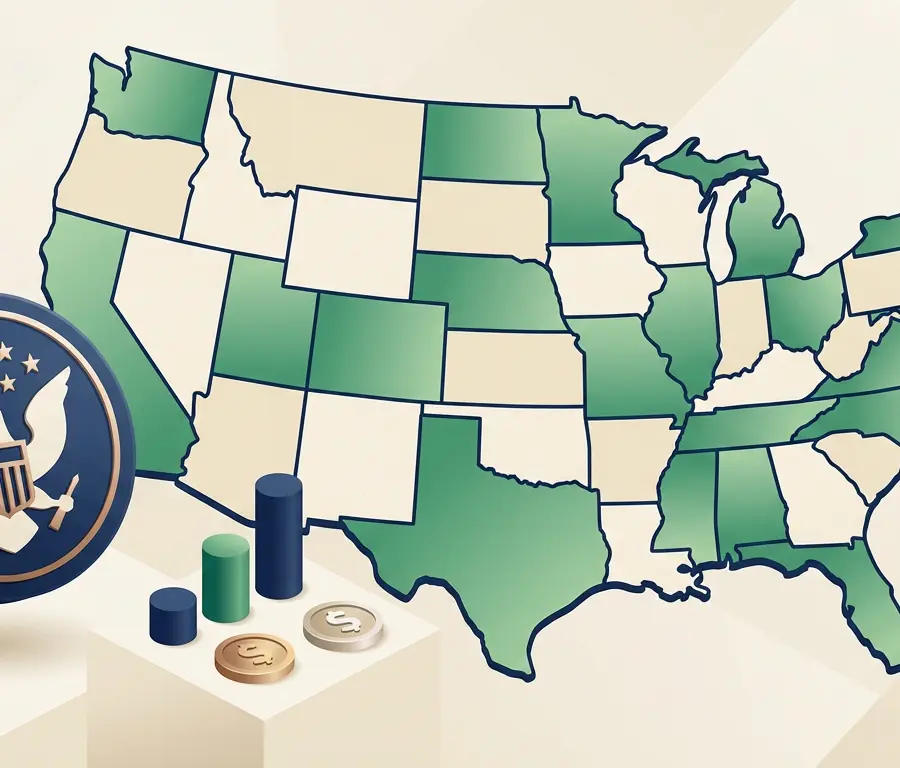
The geographic distribution of 7(a) lending follows predictable patterns driven by small business density, lender participation, and economic scale. Large states with extensive small business populations - California, Texas, Florida, New York, and Illinois - consistently account for the largest absolute volumes of 7(a) lending activity.
SBA lender reports provide state-by-state summaries of loan approvals through the open data portal at data.sba.gov. These reports can be filtered by fiscal year, lender type, and congressional district, enabling granular analysis of lending patterns (SBA Open Data).
- Volume Billions
- Loan Count Thousands
The concentration of lending in high-population states reflects the underlying distribution of small businesses rather than any programmatic preference. However, several factors create variation in lending intensity even after controlling for state size:
Lender density and engagement: States with numerous active community banks and SBA-preferred lenders tend to show higher per-capita 7(a) lending. The program's reliance on private-sector origination means that small business owners in areas with limited bank branch presence may face greater difficulty accessing SBA-guaranteed financing.
Industry composition: Certain industries demonstrate higher propensity to seek SBA-guaranteed financing. States with concentrated hospitality, retail, or professional services sectors may show elevated 7(a) activity relative to states dominated by industries with different financing patterns.
Community Advantage participation: The SBA's Community Advantage initiative, launched in partnership with Community Development Financial Institutions, expanded 7(a) access to mission-focused lenders serving underserved communities (CDFI Fund, 2010). States with active CDFI presence show distinctive lending patterns, particularly for loans up to $250,000.
Regional Analysis: Metropolitan and Rural Patterns
The 2026 Firms in Focus chartbooks from the Federal Reserve Banks break down small business credit data by metropolitan statistical area as well as state, revealing important within-state variation (Federal Reserve Banks, 2026). Metropolitan areas consistently show higher absolute volumes of small business lending, but rural regions demonstrate greater relative dependence on SBA-guaranteed financing as a share of total credit access.
This urban-rural divide reflects structural differences in banking infrastructure. Federal Reserve research on Community Reinvestment Act performance notes that credit card lenders - which typically lack extensive branch networks - made up a larger share of loan origination volume in non-low-and-moderate-income areas than in LMI areas, with this gap widening over time from 9.1% versus 6.9% in 2010 to 21.7% versus 19.0% in 2016 (Federal Reserve, 2018). This pattern suggests that traditional relationship-based small business lending remains more concentrated in areas with robust community bank presence.
For rural small businesses, the SBA 7(a) program often serves as a crucial bridge to credit that might otherwise be unavailable. The federal guarantee enables lenders to extend financing in markets where they might otherwise face unacceptable concentration risk or limited collateral options.
- Non Lmi Areas
- Lmi Areas
The Federal Reserve's state-level chartbooks enable analysis of how credit conditions vary across geographic categories within each state. The state and district chartbooks released through the Firms in Focus initiative provide data disaggregated by city, state, industry, owner demographics, and firm size - enabling researchers to examine lending patterns at multiple levels of geographic granularity (Federal Reserve Banks, 2025).
Lender Participation by State
The SBA's 7(a) and 504 Lender Report summarizes loan approvals by state and lender, providing insight into the concentration of lending activity across financial institutions (SBA, Open Data). This data reveals significant variation in lender participation across states.
In some states, a small number of high-volume lenders account for the majority of 7(a) originations. These often include large regional banks with dedicated SBA lending units and specialized non-bank lenders focused on government-guaranteed programs. In other states, lending distributes more evenly across numerous community banks, each originating a modest volume of SBA-guaranteed loans.
The FDIC's Small Business Lending Survey provides context on how banks approach this segment. The survey, sponsored by the FDIC and administered by the U.S. Census Bureau, asks banks about their small business lending practices and volumes (FDIC). This nationally representative survey reveals that banks consider multiple factors when deciding whether to participate in SBA-guaranteed lending, including the administrative requirements of program participation, the guarantee percentages available, and the creditworthiness of potential borrowers in their service areas.
Smaller community banks often maintain proportionally higher engagement with SBA programs relative to their overall lending volume. For these institutions, the federal guarantee enables them to serve small business customers who might otherwise need to seek financing from larger regional competitors.
Congressional District Analysis
SBA lending reports include congressional district-level data, enabling analysis of how 7(a) activity distributes within states. The Congressional District Approvals Report summarizes loan activity for both 7(a) and 504 programs, with additional tabs for Community Advantage activity by congressional district and Microloan activity by state (SBA Open Data, 2023).
This granular data supports several analytical applications:
- Constituent services: Elected officials can assess program performance within their districts and identify potential gaps in small business lending access
- Economic development targeting: State and local agencies can compare lending patterns across districts to identify areas where additional outreach or technical assistance might stimulate loan uptake
- Lender recruitment: The SBA and its partners can use district-level data to identify markets where additional lender participation might expand credit access
Variation across congressional districts within a single state can be substantial. Districts containing major metropolitan business centers typically show far higher loan volumes than rural districts, but the per-business lending rate may differ less dramatically when accounting for small business density.
Community Advantage and Mission-Focused Lending
The SBA's Community Advantage initiative opened the 7(a) program to CDFIs and other mission-focused lenders beginning in 2010, expanding the roster of institutions able to originate SBA-guaranteed loans (CDFI Fund, 2010). This initiative enables lenders with specific community development missions to offer 7(a) loans up to $250,000 to underserved borrowers.
Community Advantage lending shows distinctive geographic patterns compared to traditional 7(a) originations. Mission-focused lenders concentrate their activity in low-and-moderate-income census tracts and serve higher proportions of minority-owned and women-owned businesses. States with robust CDFI infrastructure - often those with state-level CDFI support programs or strong community development ecosystems - show elevated Community Advantage activity.
The program participant guide for Community Advantage outlines the requirements for lender participation, noting that approved lenders execute an SBA Form 750CA and must comply with standard SBA loan program requirements unless specifically waived in the Federal Register Notice (CDFI Fund, 2011).
- Percentage
Community Advantage represents a relatively small portion of overall 7(a) volume but plays a disproportionate role in reaching underserved communities and borrowers who might face barriers to accessing conventional SBA lenders.
Pandemic Program Effects on Baseline Data
Analysis of recent 7(a) lending data must account for the substantial effects of pandemic-era emergency programs on small business credit patterns. The Census Bureau publishes experimental Business Dynamics Statistics covering SBA COVID Response recipients, enabling researchers to examine how emergency programs like the Paycheck Protection Program affected firm survival and credit-seeking behavior (Census Bureau, 2025).
Treasury and SBA released detailed loan-level data on PPP lending, including business names, addresses, NAICS codes, demographic information, and loan amounts (Treasury, 2020). This data, covering loans through August 2020, showed substantial variation in program uptake across states and industries.
The pandemic programs created both a temporary surge in federal small business lending and lasting effects on borrower and lender behavior. Many businesses that received PPP loans later sought traditional 7(a) financing as they transitioned from emergency support to growth capital. Lenders that participated heavily in PPP developed or expanded their SBA lending capabilities, potentially increasing their ongoing 7(a) activity.
These dynamics complicate interpretation of recent lending trends. The record 7(a) volume in fiscal year 2025 reflects genuine program growth but also occurs against a baseline that was disrupted by emergency lending programs. Historical comparisons should acknowledge these structural shifts.
Credit Conditions by State: Survey Evidence
The Federal Reserve's Small Business Credit Survey provides demand-side perspective on credit access that complements supply-side SBA lending data. The 2026 Firms in Focus chartbooks break down survey findings by state, enabling analysis of how small business owners' credit-seeking behavior and outcomes vary geographically (Federal Reserve Banks, 2026).
Key metrics available at the state level include:
- Application rates: The share of small businesses that applied for credit in the survey period
- Approval rates: The share of applicants receiving all or most of the financing they sought
- Source preferences: The types of lenders to which businesses applied (large banks, small banks, online lenders, CDFIs, etc.)
- Financing gaps: The share of businesses that experienced a shortfall between requested and received financing
These survey data reveal important context that lending volume data alone cannot capture. A state might show relatively low 7(a) lending volume because businesses face barriers to accessing credit or because strong economic conditions reduce demand for SBA-guaranteed financing. The survey data helps distinguish between these scenarios.
The 12 Federal Reserve Banks coordinate on survey methodology and reporting, ensuring comparability across regions (Federal Reserve Banks, 2025). The state and district chartbooks released through Firms in Focus enable analysis by multiple dimensions simultaneously - for example, examining credit conditions for minority-owned businesses in a specific state or industry.
Implications for Small Business Owners
Understanding Your State's Lending Landscape
Small business owners seeking SBA 7(a) financing benefit from understanding their state's lending landscape. Key considerations include:
Lender availability: States with numerous active SBA lenders offer borrowers more options and potentially more competitive terms. The SBA's lender reports identify which institutions originate the most loans in each state, providing a starting point for lender identification.
Community bank presence: In states where community banks maintain significant SBA lending activity, relationship-based lending approaches may be particularly effective. Building a banking relationship before seeking loan financing can improve access and terms.
CDFI options: In states with active Community Advantage lenders, mission-focused financing may be available to businesses in underserved communities or those owned by members of underrepresented groups.
Navigating Geographic Disparities
Businesses in states or regions with lower 7(a) lending intensity may face greater challenges accessing SBA-guaranteed financing. Strategies to address these barriers include:
- Expand lender search: Consider lenders beyond the immediate local market. Some high-volume SBA lenders operate across state lines and may serve borrowers in underserved areas.
- Leverage technical assistance: SBA resource partners including Small Business Development Centers and SCORE chapters can help borrowers prepare loan applications and identify appropriate lenders.
- Consider alternative SBA programs: The 504 loan program for fixed assets and equipment, or the Microloan program for smaller financing needs, may offer better access in some markets.
Timing and Program Changes
The SBA periodically adjusts program parameters including guarantee percentages and fee structures. During periods of economic stress, Congress has authorized temporary enhancements such as increased guarantees (up to 90%) and fee waivers (Treasury). Monitoring program announcements can help borrowers time their applications to take advantage of favorable conditions.
Policy Implications and Recommendations
For Policymakers
Address geographic disparities in lender participation: The concentration of 7(a) lending among a relatively small number of high-volume lenders leaves some regions underserved. Policies that reduce administrative burden for smaller lenders or provide incentives for entering underserved markets could improve geographic distribution.
Strengthen Community Advantage: The Community Advantage initiative demonstrates that mission-focused lenders can effectively extend SBA-guaranteed financing to underserved borrowers and communities. Permanent authorization and expanded capacity for this program would enhance geographic equity.
Improve data transparency: While the SBA publishes substantial lending data, state-level analysis would benefit from more standardized reporting on borrower characteristics, loan performance, and lender concentration. The experimental BDS-SBA COVID data from Census demonstrates what richer integrated datasets could enable.
For Lenders
Evaluate SBA program participation: Banks not currently originating 7(a) loans may be missing an opportunity to serve creditworthy small business customers. The federal guarantee reduces risk exposure while maintaining private sector underwriting discipline.
Consider geographic expansion: High-volume SBA lenders may find growth opportunities by extending service to underserved markets. The program's standardized requirements facilitate lending across state lines.
Leverage secondary market: The SBA 7(a) secondary market enables lenders to sell guaranteed portions of loans, managing balance sheet exposure while maintaining customer relationships. Treasury's historical support for this market provides confidence in its ongoing liquidity (Treasury, 2013).
For Industry Associations and Advocates
Use state-level data for advocacy: The combination of SBA lending reports and Federal Reserve survey data enables evidence-based advocacy for small business credit access. Identifying gaps between credit demand and SBA lending activity can support requests for targeted interventions.
Facilitate lender recruitment: State and local business organizations can play a role in encouraging additional lenders to participate in SBA programs, particularly in underserved markets.
Limitations and Future Research Directions
This synthesis is subject to several limitations that affect interpretation:
Data currency: Federal data releases involve inherent lags. The most recent complete fiscal year SBA data covers FY2025, and Federal Reserve survey data reflects the 2025 survey cycle with publication in 2026. Economic conditions may have shifted since data collection.
Supply versus demand: Lending volume data alone cannot distinguish between supply-side constraints (lender availability, underwriting standards) and demand-side factors (economic conditions, business formation rates, alternative financing preferences). The Federal Reserve survey data helps address this limitation but relies on self-reported information.
Program complexity: The 7(a) program encompasses multiple sub-programs with different characteristics, including Community Advantage, Express loans, and standard 7(a) originations. State-level aggregates may mask important variation across these program types.
Future research directions include:
- Integration with firm dynamics data: The Census Bureau's Business Dynamics Statistics, including the experimental BDS-SBA COVID datasets, enable analysis of how SBA lending affects firm survival and growth. More systematic integration of lending and firm-level data would strengthen causal inference.
- Lender behavior analysis: While the FDIC Small Business Lending Survey provides valuable context, more detailed analysis of how individual lenders make SBA participation decisions would inform strategies for expanding geographic coverage.
- Long-term outcome tracking: Analysis of loan performance by state and borrower characteristics would help identify whether observed lending patterns produce equitable outcomes across geographic markets.
Conclusion
The SBA 7(a) loan program demonstrates both remarkable scale and persistent geographic variation in its distribution across states. Record 7(a) lending in fiscal year 2025 - 77,600 loans totaling $37 billion, contributing to a combined 7(a) and 504 agency total of 84,400 loans for $44.8 billion - reflects strong program performance, but analysis of state-level patterns reveals substantial disparities in credit access (SBA, 2025).
These disparities reflect the program's reliance on private-sector lender participation, which concentrates activity in areas with robust community banking infrastructure and active SBA-preferred lenders. Mission-focused initiatives like Community Advantage partially address these gaps but remain a small share of overall volume.
For small business owners, understanding state and local lending landscapes can inform effective credit-seeking strategies. For policymakers and advocates, the combination of SBA lending data and Federal Reserve survey evidence enables targeted interventions to improve geographic equity in small business credit access.
The federal data infrastructure supporting this analysis continues to improve, with the 2026 Firms in Focus chartbooks providing unprecedented state-level detail on small business credit conditions (Federal Reserve Banks, 2026). Continued investment in data collection and transparency will strengthen the evidence base for policy decisions affecting millions of small businesses across all 50 states.
Frequently asked questions
Sources(14)
- 1.SBA 7(a) Loan Program InformationU.S. Small Business Administration · Accessed 2026-04-21
- 2.SBA Office of Capital Access DatasetsU.S. Small Business Administration · Accessed 2026-04-21
- 3.SBA Lender ReportsU.S. Small Business Administration · Accessed 2026-04-21
- 4.2026 Firms in Focus Chartbooks on Small Business DataFederal Reserve Banks · Accessed 2026-04-21
- 5.Availability of Credit to Small Businesses - October 2022Federal Reserve Board · Accessed 2026-04-21
- 6.Recent Trends in Small Business Lending and the Community Reinvestment ActFederal Reserve Board · Accessed 2026-04-21
- 7.Small Business Lending Survey 2024 - Section 2 FundamentalsFDIC · Accessed 2026-04-21
- 8.Small Business TopicsFDIC · Accessed 2026-04-21
- 9.FDIC Quarterly Banking ProfileFDIC · Accessed 2026-04-21
- 10.SBA 7(a) Securities Purchase ProgramU.S. Department of the Treasury · Accessed 2026-04-21
- 11.SBA 7(a) OverviewU.S. Department of the Treasury · Accessed 2026-04-21
- 12.SBA Paycheck Protection Program Loan Level DataU.S. Department of the Treasury · Accessed 2026-04-21
- 13.Programs and Surveys Contributing to Small BusinessU.S. Census Bureau · Accessed 2026-04-21
- 14.New SBA Community Advantage InitiativeCDFI Fund · Accessed 2026-04-21
Funding Estimator
Compare options for your business
Day-to-day operations, payroll, inventory.
Illustrative estimate only. Actual rates, terms, and eligibility depend on your application.
Continue exploring
Related questions
Tools & calculators
Ready to see what your business qualifies for?
Check eligibility in minutes. It won't impact your credit score.